Contents
The next family that visits your church may have asked ChatGPT about you before they ever saw your website. And if the AI doesn't know you exist, they'll walk into the church down the street instead.
I've spent 17 years in SEO and marketing, and a good chunk of that time with churches. I've watched church websites go from "we have a website" to "we have a website with a sermon player that works on phones." Big wins. But AI search is a bigger shift than any of that, and most churches haven't noticed yet.
This isn't about gaming an algorithm. It's about making sure that when someone is curious about faith, lonely, or new in town and asks a machine where to go, your church is part of the answer.

The moment I realized churches had an AI problem
The story below is an illustrative example, a composite of the kinds of conversations I have with church visitors.
A young couple had just moved to San Diego for a job. They'd grown up in church but drifted in college, and with a baby on the way they wanted to try again. The wife didn't Google churches. She opened ChatGPT and typed something like: "We just moved to Clairemont. We want a church that's casual, has a good nursery, and won't make us feel weird for not being there in five years."
ChatGPT gave her three names. She visited the first one, and they've been there ever since.
That got me curious, so I ran the same kind of question for a church I was working with. Great people, strong kids ministry, a nursery with better security than most banks. ChatGPT didn't mention them once. It recommended two churches with thinner ministries but a lot more chatter online: reviews that described the Sunday experience, a couple of Reddit threads where people said "we tried a bunch and loved this one," and websites that answered the exact questions a nervous visitor asks.
The church wasn't failing at ministry. It was invisible to the thing people were asking.
People are already asking AI about faith
This isn't a future trend. It's happening in your pews and in your parking lot right now.
| Finding | Source |
|---|---|
| About 30% of US adults say spiritual advice from AI is as trustworthy as advice from a pastor. Among Gen Z and Millennials, it's two in five. | Barna and Gloo, Feb 2026 |
| Roughly four in ten practicing Christians say AI has helped them with prayer, Bible study, or spiritual growth. | Barna and Gloo, Feb 2026 |
| Only 12% of pastors feel comfortable teaching on AI. | Barna and Gloo, Feb 2026 |
| About 6% of Americans use AI for spiritual guidance, roughly the same as the combined number of Jews, Muslims, Hindus, and Buddhists in the US. | NPR/Ipsos, Sept 2026 |
To be fair, Ipsos also found people still lean on friends and family far more than AI for personal counsel. That's actually good news for churches. AI isn't replacing community. It's becoming the front door to it. People ask the AI where to look, and then they go find humans.
The question for your church isn't "should we care about AI?" It's "what does AI say about us when someone asks?" If you want a structured way to find out, start with the AI visibility audit.
The AI signals that decide which churches get recommended
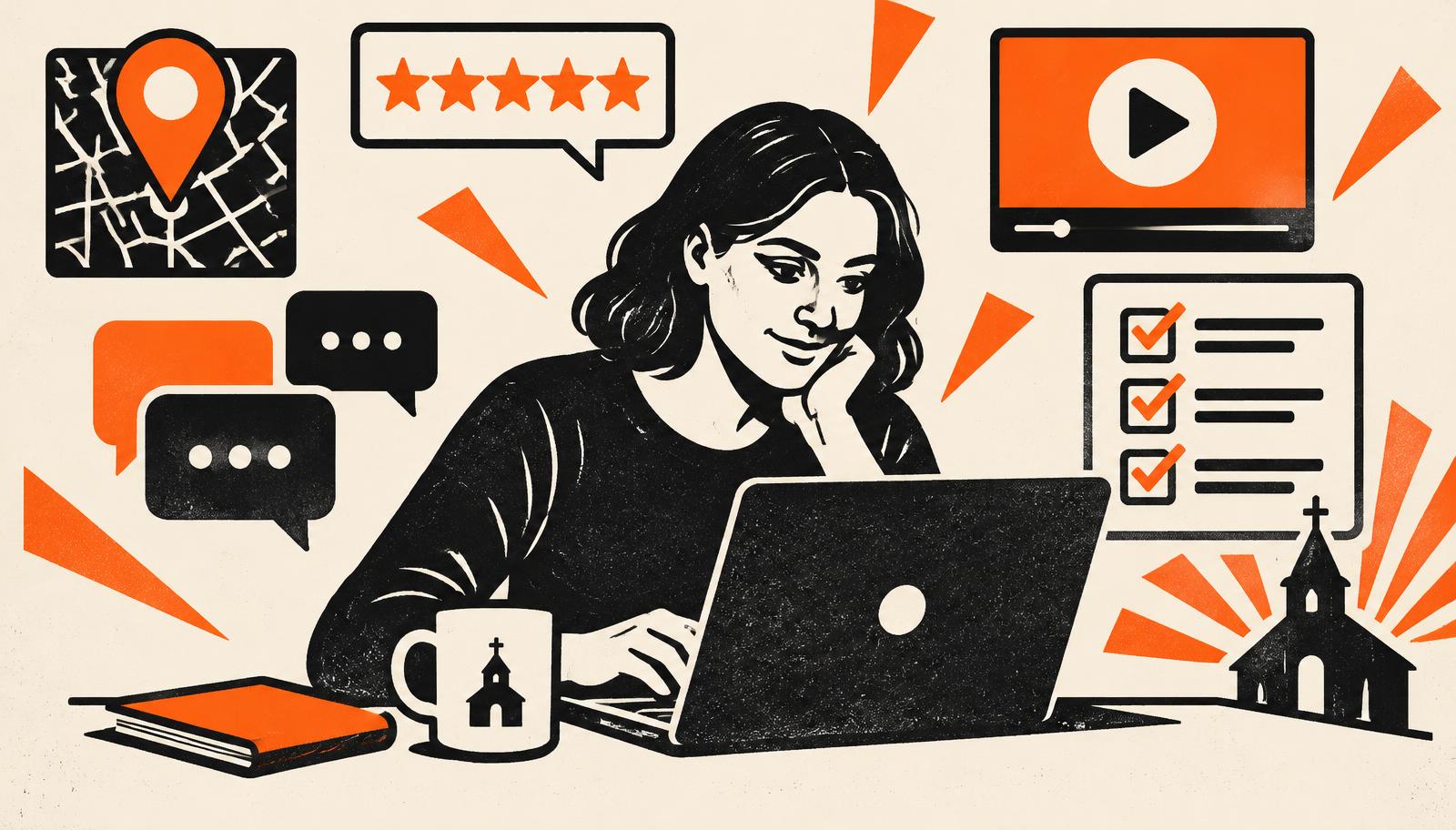
AI tools don't recommend the church with the best preaching. They recommend the church they can find the most clear, trustworthy, consistent information about. Here are the signals I look at first.
| Signal | Why AI cares | What your church can do |
|---|---|---|
| Reddit conversations | Reddit is the #1 cited domain in ChatGPT, at 16.7% of citations (Ahrefs), and ranks first or second on every major AI engine (Peec) | Show up honestly in your city's subreddit when people ask about churches (more below) |
| Google reviews | Reviews describe what Sunday actually feels like. Claude in particular leans two to four times harder on reviews and social sources than other models (Yext via Xponent21) | Ask members to write reviews that describe the experience: parking, kids check-in, the vibe, the coffee |
| Google Business Profile | AI pulls service times, address, and categories from local listings (Reach Right) | Keep hours, holiday services, photos, and denomination accurate. Answer the Q&A section |
| A "Plan Your Visit" page that answers real questions | AI needs plain answers it can quote | Answer what to wear, how long service runs, what kids do, where to park, and what you believe, in plain sentences |
| Consistent info everywhere | Conflicting service times make AI less confident about you | Match your name, address, and times across your site, Google, Facebook, Yelp, and church directories |
| Sermons and video | YouTube is the #2 cited domain across AI engines (Peec) | Post sermons with real titles and descriptions, not "Sunday 10/19" |
| Local news and community mentions | Third-party coverage reads as proof you're real and active | Get your food pantry, VBS, or community event in local news and partner websites |
Notice how few of these are about your website. Your website is what you say about yourself. Almost everything else is what other people say about you, and that's what AI trusts most.
Want to go deeper on any one signal? See how to build a Plan Your Visit page, how to keep your church information consistent, and the Church SEO guide for Google Business Profile basics.
Not Another Church Marketing Conference
Join us at the conference.
A two-day working conference for church marketing and communications professionals. Work on your church's marketing with expert help, rather than just listening to presentations.
February 18–19, 2027 · Torrey Pines Church, San Diego · 30 seats · $599 · Application only.
Reddit for churches (without being weird about it)
I know. "Reddit" and "church" in the same sentence makes some pastors nervous. Fair. Reddit can be a rough neighborhood. But it's also where a lot of people ask the questions they won't ask out loud: "Is there a church in Chula Vista that's okay with doubters?" or "Any churches that don't feel like a concert?"
Those threads are exactly what ChatGPT reads when someone asks it a similar question. If your church isn't in them, the AI has less to work with.
Here's how I coach churches to show up there:
- Search first, post later. Look up your city subreddit plus "church" and see what people are already asking and saying about you.
- Answer as a person, not a brand. A staff member or pastor replies under their own name, says where they serve, and actually answers the question. Even when the honest answer is "we might not be the best fit for that, but here's a church that is."
- Respond to criticism with grace. If someone had a bad experience at your church, a calm, humble reply does more for your reputation (and for the person) than silence.
- Let members be members. Don't organize a posting campaign. Just let your people know that if they're on Reddit and someone asks, an honest recommendation helps more than they think.
- Follow each subreddit's rules. Many local subs limit self-promotion. Respect it, or you'll get removed and roasted, in that order.
A 30-day AI visibility checklist for church staff
You don't need a marketing department for this. A volunteer with a laptop and a few hours a week can knock most of it out.
Week 1: See what AI says about you
- Ask ChatGPT, Claude, Gemini, and Perplexity 10 questions a visitor would ask ("best church for young families in [your city]," "what is [your church] like?")
- Write down which churches get named and what sources show up
- Note anything the AI gets wrong about you
Week 2: Fix the basics
- Update your Google Business Profile: service times, holiday schedule, photos, categories
- Make your name, address, and service times match everywhere online
- Build or rewrite your "Plan Your Visit" page with plain answers to real visitor questions
Week 3: Grow what others say
- Ask 10 to 20 members to leave Google reviews that describe the actual Sunday experience
- Search Reddit for your city plus "church" and reply honestly where it helps
- Retitle your last 10 sermon videos so the titles say what each sermon is about
Week 4: Re-check and repeat
- Run the same 10 AI questions again and compare
- Put a monthly reminder on the calendar to repeat the check
For a fuller tracking setup, see how to measure your church's AI visibility.
What not to do
- Don't fake reviews or Reddit posts. It's dishonest, it breaks platform rules, and nothing kills a church's reputation faster than getting caught. We of all people should know better.
- Don't write for robots. Stuffing "best church in San Diego" into every paragraph reads terribly to humans, and AI isn't fooled either. Write like you're answering a nervous first-time guest.
- Don't hide what you believe. Clear beliefs help AI match you with the right people. Vague pages get you vague recommendations.
- Don't panic. You don't need to chase every AI update. Clear info, honest reviews, and real community conversation will hold up through whatever changes next.
FAQ
Do people really use ChatGPT to find a church?
Yes, and it's growing. Barna and Gloo found that two in five Gen Z and Millennial adults trust AI's spiritual advice as much as a pastor's, and church marketing firms report people asking AI full questions like "find a family-friendly church in my city with a good kids program."
What is AI search optimization for churches?
It's making sure AI tools like ChatGPT, Claude, and Gemini can find accurate, trustworthy information about your church, so they recommend you when someone asks. The AI Search Optimization guide covers the full framework.
Should my church be on Reddit?
You don't need an official church account. But someone on staff should know what's being said about you in your local subreddit and respond honestly when it helps.
How do I know if AI is recommending my church?
Ask it. Run the same 10 visitor-style questions in each AI tool every month and track whether your church is named and described accurately.
Is this different from regular church SEO?
It overlaps a lot. Accurate listings and helpful pages still matter. The big difference is that AI leans much harder on what other people say about you: reviews, Reddit, videos, and local news.
The bottom line
The Great Commission didn't come with an SEO clause, but it did come with "go." Today, a lot of people start their search for a church by asking a machine. Make sure it knows who you are, what Sunday feels like, and that the coffee's decent.
If you want to dig into this with a small room of church communicators who are tired of the usual conference playbook, that's exactly what we're building at Not Another Church Marketing Conference.
Sources
- AI is Becoming a Spiritual Authority in Americans' Lives, Barna Group and Gloo
- A surprising number of Americans use AI for spiritual reasons, NPR via KPCW
- Voice Search and AI for Churches (2026), Reach Right
- The 50 Most-Cited Websites in ChatGPT (July 2026), Ahrefs
- Reddit in AI search, Peec
- Most-cited domains in AI search, Peec
- Claude's web search and citation sources, Xponent21
Not Another Church Marketing Conference
Apply to attend the conference.
A two-day working conference for church marketing and communications professionals. Work on your church's marketing with expert help, rather than just listening to presentations.
February 18–19, 2027 · Torrey Pines Church, San Diego · 30 seats · $599 · Application only.